
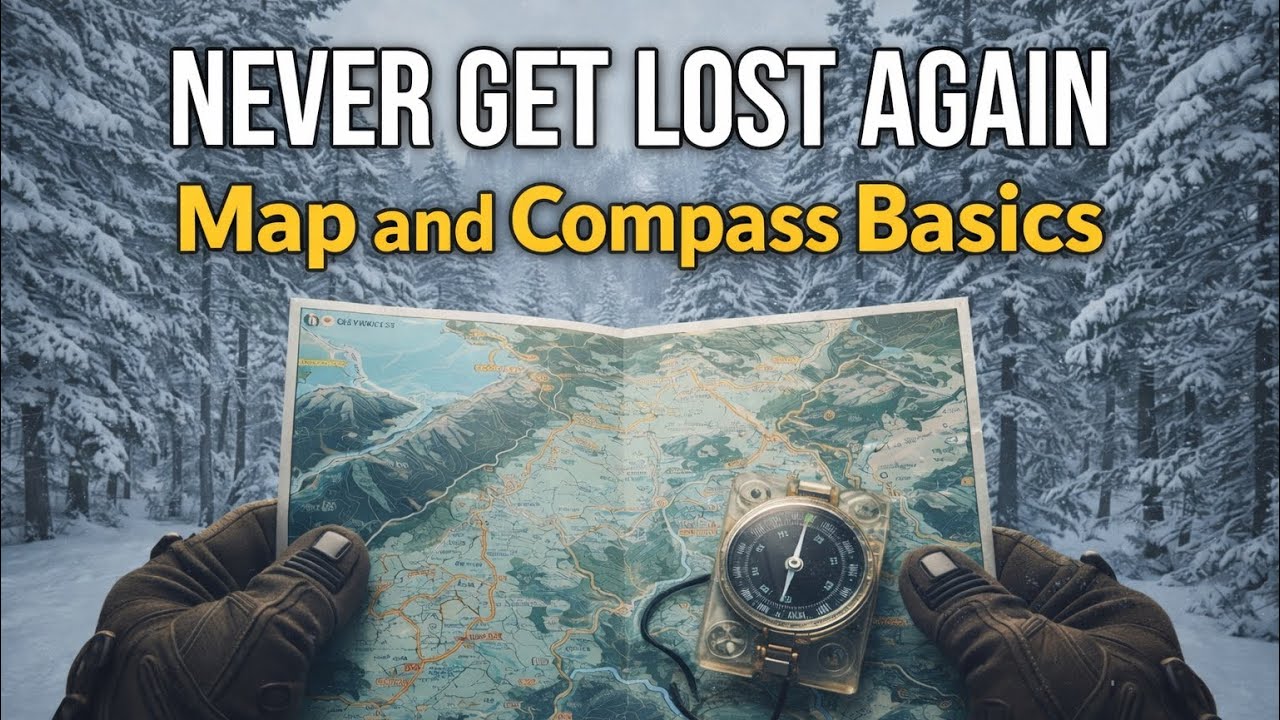
Learning map and compass basics is the single most important skill you can have in the Maine North Woods, and relying solely on a GPS is a mistake I see too often. We’ve all been there—the screen goes blank in the freezing cold, the batteries die miles from the truck, or you’re so deep in a hollow there’s no signal. Your technology has failed, and now you have a real problem. That’s when this timeless skill becomes your lifeline.
Unlike a GPS, a quality compass doesn’t need batteries or a satellite signal. It works every time, all the time. It’s the ultimate backup, and honestly, it should be your primary tool for building true situational awareness in the woods. Having the confidence to navigate the old-fashioned way is what allows you to push deeper on a deer hunting track or explore that new ridge line without the constant fear of getting turned around. This isn’t just theory; it’s a practical skill that has saved lives.
Understanding Declination: The Real North
One of the first hurdles for folks is a word that sounds complicated but isn’t: declination. It’s simply the difference between Magnetic North (where your compass needle points) and True North (the top of your map). Here in Maine, that difference is significant. Every good topographic map has a diagram showing you the exact declination for that area. Setting your compass to account for this is the critical first step to making your map and compass work together. Mastering this is a core part of good map and compass basics.
Orienting Your Map: Where The Magic Happens
Once you’ve set your declination, the next step is to orient your map to the world around you. This is how you make the paper in your hands match the terrain at your feet. It’s simple:
- Lay your map on a flat-as-possible surface.
- Place your compass on the map, with the north-south lines on the compass baseplate aligned with the north-south lines on the map.
- Without moving the compass from the map, turn both the map and compass together until the red magnetic needle is inside the red outline of the orienting arrow (we call it “putting red in the shed”).
That’s it. Your map is now oriented. The road on the map is pointing the same direction as the real road. The mountain on the map is in the same direction as the real mountain. This is the foundation of real-world navigation and essential for anyone on a remote moose hunting trip.
Taking a Bearing: Your Path Forward
With your map oriented, you can now take a bearing to a landmark or your intended destination. You simply point your compass’s direction-of-travel arrow at your target and read the bearing. This gives you a precise direction to follow. It’s the skill that gets you from point A to B, whether you’re navigating to a hidden pond or finding your way back to your trapping line after a snowfall. Knowing these map and compass basics is simply non-negotiable for serious outdoorsmen.
These skills aren’t just about survival; they’re about confidence and self-reliance. Always carry a map of your area, which you can get from sources like the Maine Dept of Inland Fisheries & Wildlife, and practice these techniques. Mastering these fundamental map and compass basics is what separates a prepared woodsman from a potential statistic.
Want to learn this skill hands-on from a pro? We teach navigation as part of our guided nature hikes and hunting trips. Book a trip with us and build the confidence to explore anywhere.
From the Field
More From Our Guides
 Ice Fishing Trap Setup: Bait, Depth and the Strike ZoneRead the article →
 How to Prep Your Ice Fishing Traps Before First IceRead the article →
 Two-Minute Tips: Mastering Basic Scent Control for HuntingRead the article →
 Nuisance Wildlife Management: Pro-Tips from a Registered Maine GuideRead the article →